COURSE
REVIEWS
Grave Satisfaction
Found at Fairfax National
By Jeffrey
A. Rendall,
TravelGolf.com Senior Writer
Images courtesy: Keith Paton and Fairfax National
Centreville, VA - There are numerous golf courses in Virginia that play on a Civil War theme, and thats appropriate. For this state was home to more battles, more casualties and more property destruction than any other during the War Between the Statesits only natural that recreational attractions should capitalize on these facts by linking themselves to the conflict. After all, its instant name recognition. But only a few tracks can authentically claim to rest on actual battlefield earth. Fairfax National is one of those.
The property was not physically fought over with musket ball and cannonbut it served as a field hospital site after the two sizeable battles that occurred only a cavalry charge away. The ground also figured into troop movements before and after the battles. In other words, many a soldier in blue and gray trod over its hallowed ground. And some of their remains are still there.
Abraham Lincoln said at Gettysburg, when dedicating the National Cemetery on the Pennsylvania Battlefield: The world will little note, nor long remember what we say here. But it can never forget what they did here.
Thats pretty much true for the golf at Fairfax National, tooits hard to forget what they did theremainly because theres a gravestone that silently marks the final resting place of a Confederate soldier mortally wounded during the Battle of Second Manassas (for Yankees, thats 2nd Bull Run).
The stone lies just off the green on the finishing hole of the Wilderness nine, but doesnt really come into play. It serves as a reminder that once upon a time, much more serious matters occurred on and around the property.
Its a good thing there is such a reminder, because the golf
at Fairfax Nationals not set up that wayfull of grim
markers. The course is primarily a fun and enjoyable place to
play the game. No life or death situations (in the golf sense)
here to remind you that there were once horrible scenes depicted
on this piece of earth in centuries past.
The clubs head pro, Brian Armstrong, perhaps described it most appropriately when he remarked: I think the best thing about our course is its not like a lot of the newer vintage courses in the area. Since it was built in 1959, its got a lot more of the old-style feel of golfmeaning its fun and allows room for error. In the old days, you didnt have to contend with 10-foot high fairway bunkers or 200 yard forced carriesand you dont have that here either.
There are no blind or trick shots, and you can run the ball up to just about every green. From the tee, its very wide open, with few chances to get in serious trouble. For that reason, its quite accessible to beginners, ladies and seniors. But theres also challenge out therebecause the greens are so small, the lower handicap players must hit good iron shots to make them. And once there, they tend to roll pretty fast. Theres something to offer just about every type of golfer here.
I wouldnt exactly call it easy, but Fairfax National doesnt contain nearly the visual intimidation thats so much a part of newer vintage golf layouts. Its very flat for a Northern Virginia course, and only the holes along the property boundaries would have traditional out-of-bounds. If you slice a drive off the first tee on the Antietam nine (as well as many other holes), you can play it from virtually anywhere the ball ends up. It certainly takes a lot of the pressure off the opening shot of the round.
Despite the open nature of the course with a lot of parallel fairways,
the links dont really feel scrunched together. There are
generous spaces in between the holes, so even if you do hit a
wayward ball, theres enough cushion where you wont
have to worry about maiming someone on an adjoining fairway. Thats
good--there was enough blood soaking the soil in the early 1860s
to last for centuries.
Three nines, all named after famous Civil War battles, make up Fairfax National. We played the Antietam nine as our front, and the Bull Run nine as our inward links. Bull Runs the newest of the three, and also has the most contour and variety of the trio. The Wilderness nine is sandwiched in between the other two, and was formerly the back nine when the course was a private club prior to 1998.
If you piece any two of the nines together, theyll play at or near 7,000 yards from the back tees (and a par of 73 if you play Bull Run, par 37)so youll definitely have to bring your long game. The white tees will play to about 6,600, and the ladies about 5,400. A fourth mens tee plays about 6,000 yards. Slope rating for the Antietam and Bull Run nines together is 130 (from the back tees).
The Antietam nine begins with a couple straight-away par fours at 415 and 375 yards respectively. As noted above, the first holes tee shot is wide open, with only minor trouble in the form of woods on the left-hand sidebut even there youll have to hook it badly to reach it. The second hole features a pair of fairway bunkers (one on each side) to keep you honest when driving.
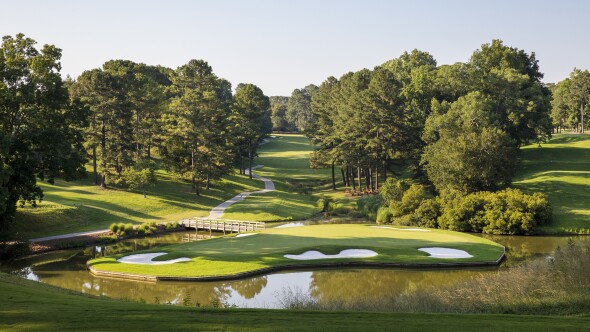
The third hole presents more of a challenge. 405 yards and slightly downhill, youll have to try and fade the drive off the tee to give yourself the best angle into the greenbut dont fade too much as rough and trees hug the right side. If youre too close to the cart path along that side, youll probably have to lay up, as I did. The second shots over water to a small green, sloping back to front. Any shot long and youll face a treacherous downhill chip that tempts the water. Aim for the center and take your chances with the flat stick.
Another good hole is the fifth. Measuring 418 yards from the back,
you might want to hit a three-wood or long iron off the tee, depending
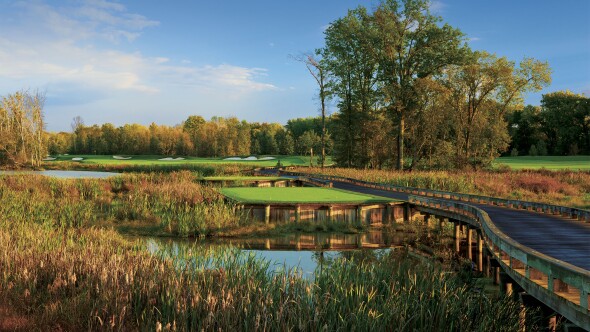
on the box placementbecause theres a marshy pond that
bisects the fairway about 260 yards out. Cut off as much distance
as you can off the tee, or leave yourself a long iron into the
green, which is protected by a bunker short and right. Im
sure the rakes well worn in that one.
The Bull Run nine starts out with a good risk-reward par five at 496 yards. Choices abound on both the first and second shots, and you must execute both well to have a putt for eagle. Armstrong presents the dilemma: Since its a slight dogleg left, you can pull out the driver and try and take it around the corner--setting up a reachable second shot. But if you dont tee it well, you can be short and in trouble or long through the fairway in trouble. With the second shot, theres water surrounding the green on the sides and backyoull have to hit a very accurate long iron into it. The greens smallbut if you make it, youll definitely have a chance for eagle.
|
But I didnt let it ruin the round. The nature of the course and the propertys history wouldnt allow me anything less than a good time. There may be some courses around thatll excite you more, but there arent any where youll have more fun. And you might even learn something.
Fairfax National Golf Club
16850 Sudley Road
Centreville, VA 20120
Phone: (703) 631-9226
FAX: (703) 631-1318
Website: www.GothamGolf.com
Head Golf Professional:
Brian Armstrong
Rates:
M-F, $45; Twilight, after 3, $35.
Midweek walking--$32.
Seniors and Juniors--$40.
Sat-Sun and Holidays--$69.
Twilight is $55.
Carts are required on the weekends.
Fairfax National offers the Gotham Golf Card, which entitles you to $10 off weekday rates and $5 off weekend rates. Card costs $75, and its good for the year.