Hunting Hawk Golf Club

Rating Snapshot


About
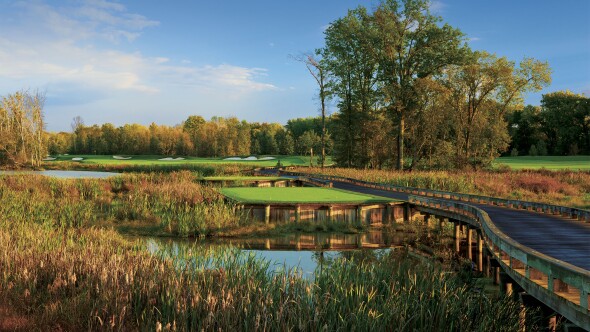
Situated along the Chickahominy River, Hunting Hawk Golf Club sprawls across a rolling landscape covered with mature trees and dotted with sparkling ponds. The natural wetlands and rugged terrain were carefully preserved. The gentle hills provide contours that are subtle but challenging. The fairways have generous, well-defined landing areas but they are flanked with sand bunkers and sculpted mounding. The undulating greens are also framed with bunkers and grass hollows. Every hole has a unique character that requires a different strategy. Hunting Hawk Golf Club's back nine is slightly tougher than the front nine. It is where most of the water comes into play. The 11th is the best birdie opportunity on the back, it is followed by the challenging 12th, which required a carry over wetlands that many balls have fallen prey to.
| Tee | Par | Length | Rating | Slope |
|---|---|---|---|---|
| Talon | 72 | 6760 yards | 72.7 | 137 |
| Black Hawk | 72 | 6404 yards | 71.1 | 134 |
| White Hawk | 72 | 5990 yards | 69.2 | 129 |
| Gray Hawk | 72 | 5400 yards | 66.6 | 122 |
| Red Hawk (W) | 72 | 5034 yards | 70.4 | 129 |
| Hole | 1 | 2 | 3 | 4 | 5 | 6 | 7 | 8 | 9 | Out | 10 | 11 | 12 | 13 | 14 | 15 | 16 | 17 | 18 | In | Total |
|---|---|---|---|---|---|---|---|---|---|---|---|---|---|---|---|---|---|---|---|---|---|
| Talon M: 72.5/132 | 414 | 330 | 499 | 452 | 369 | 150 | 481 | 203 | 567 | 3465 | 429 | 500 | 186 | 443 | 378 | 222 | 541 | 153 | 443 | 3295 | 6760 |
| Black Hawk M: 70.9/126 | 396 | 320 | 465 | 434 | 351 | 137 | 459 | 189 | 541 | 3292 | 411 | 479 | 173 | 417 | 350 | 202 | 524 | 132 | 424 | 3112 | 6404 |
| White Hawk M: 69.1/120 W: 74.8/140 | 350 | 282 | 444 | 402 | 336 | 115 | 436 | 161 | 531 | 3057 | 391 | 463 | 153 | 395 | 334 | 181 | 496 | 119 | 401 | 2933 | 5990 |
| Gray Hawk M: 66.3/113 W: 71.5/127 | 327 | 270 | 388 | 385 | 328 | 105 | 400 | 145 | 475 | 2823 | 364 | 450 | 135 | 310 | 291 | 144 | 424 | 100 | 359 | 2577 | 5400 |
| Red Hawk M: 64.5/110 W: 69.3/121 | 298 | 238 | 383 | 326 | 271 | 100 | 343 | 128 | 466 | 2553 | 333 | 447 | 130 | 300 | 269 | 139 | 415 | 96 | 352 | 2481 | 5034 |
| Handicap | 4 | 12 | 14 | 2 | 10 | 16 | 18 | 8 | 6 | 5 | 9 | 15 | 1 | 11 | 13 | 7 | 17 | 3 | |||
| Par | 4 | 4 | 5 | 4 | 4 | 3 | 5 | 3 | 5 | 37 | 4 | 5 | 3 | 4 | 4 | 3 | 5 | 3 | 4 | 35 | 72 |
Course Details
Rentals/Services
Practice/Instruction
Policies
Available Facilities
ClubhouseReviews
Reviewer Photos

Needs help
I have played several golf and fling golf rounds at Hunting Hawk and enjoyed my time but this appears to have been a tough year on the grounds.
Living about an hour away does not make this a viable option for me with the current conditions. Unless you live locally it is not worth the drive until there are some improvements.
Horrible Conditions
I've played this course for years and is usually in good shape other than players not repairing pitch marks on the greens.
However, I played recently and that has all changed. To start with they charged $35 for 9 holes at 2pm on a weekday. I realized it was high, but had already committed to playing nine with a friend.
My overall assessment is as follows:
The tee-boxes were all overrun with crabgrass and many bare spots, although the fairways were in pretty good shape. The greens were absolutely horrible! They were all covered with crabgrass, dead/bare spots, and large holes where hornets appeared to be burrowing! Most of the bunkers were unplayable, washed out, or listed as ground under repair.
The worst part is that the cashier didn't mention anything about the dreadful conditions when he took our money! That's absolutely as shady as it gets!
I realize things are tough right now with Covid19, but most of the local courses are having record sales so there is no excuse for not providing maintenance.
My hope is this course either obtains new management SOON or goes ahead and shuts down and stop price gouging and deceiving customers.
Crabgrass
The weather/conditions have taken over this course. Crab grass has taken over the tee boxes and greens. Impossible to have a putt that didn't bump around from the crabgrass. The course has handled the rain well but we are about to get a lot more so probably not going to be playable for a week.
Nice Track, horrible conditions
This course could be so good, but they clearly aren't putting money or the effort into proper maintenance. Crabgrass everywhere, around the fringe, rough, and even on the green surface. Lots of bare spots, again even on the greens. It's a nice course layout, with several interesting holes, but I won't be back given the conditions.
Not worth playing
This course has gone so far downhill. They don't even pretend to try anymore. There are non-stinging wasps that burrow holes in the greens, and leave piles of dug up dirt all over the green. They do nothing about removing the insects or the dirtpiles. On top of that, they fail to even mention it when you check in for your round, so you get out on the course and thing you are about to be stung by a bunch of hornets (turns out they do not sting, but it would have been good to give people a heads up beforehand). Many places just totally burnt out. On top of that they charge $10 for a very small bucket of range balls, higher than most good courses I've played. I would avoid this course altogether.
Great day, Fair play
Could not have picked a better day to play! Sunny out, light breeze, only about 65 degrees. Unfortunately, it rained heavy thunderstorms 36 hours prior. The course was still wet, made play difficult. The course is of average difficulty, great for locals. Priced a little high for quality. Better courses around Richmond for the same price. We were able to play as a twosome, which was nice.

Poor Conditions Spoiling A Good Course
I last played this course back in April when the grasses were still recovering from the harsh winter. At the time, the course conditions seemed to be pretty good in comparison to other courses in the area but now Hunting Hawk is at the bottom in that respect. That’s a shame because I still really like the layout here.
The primary issue is the greens. Aeration is a necessary annoyance of good course maintenance and is perfectly acceptable this time of year. What’s not acceptable is the that every green has been invaded and at times conquered by crabgrass. Some greens seem to have more of the nasty, clumpy, uneven pest than the actual putting grass. The result of half your strokes on the golf course are completely at the whim of a foreign substance. This doesn’t make for fun golf.
This is most disheartening because the rest of the course is actually very good. As I have mentioned in previous reviews I really love the layout here which gives you a variety of looks off the tee and makes you use every club in your bag. The bunkers--with their steep faces even in the fairways--are very nicely groomed and the fairways have come a long way from earlier this year.
The staff here remains friendly and the cost of a round is reasonable for the area. But the condition of the greens doesn’t warrant more than $10 right now, honestly. Charging me a buck per hole seems steep for what I’m presented with as a putting surface. Until they get that figured out, this is a stay-away for me.

It’s getting rough. Worse each year
The course conditions continue to decline. It seems the tradition here is to not replace divots in the greens. Not the case at other local courses. Tee boxes are weeds and dirt. I love the layout of this course but the conditions are starting to wear on me. It is my go to local course in the area, but even in may and June the greens were torn up with divot marks. Playing today, there were marks, weeds and bare patches. Early in the season the fairways were pretty bad. Lots of dirt patches. We had a rough winter, but even now in July it’s a mess, still dirt and a ton of weeds. They put sod on the fairways on a couple holes. With all that, the staff Is always very, very nice. Great people. I have tossed around the idea of becoming a member the last two years, but can’t commit due to the worsening course conditions. Until they start to enforce respect of course, particularly the greens, I won’t join. I will look at another course. Which stinks, because I do like this track a lot.
A Solid Course With A Unique Challenge
Having been a favorite course of mine from years ago, I decided to re-visit Hunting Hawk as soon as I could when I moved to the area a month ago. I’ve always appreciated the semi-fast, tiered greens, the good course conditioning and the value offered. This most recent round gave me a new perspective, though.
The course layout remains a unique and fun track with variations in each hole that make you plan your club selection and shot making well. What’s changed (or what I didn’t notice before) is the characteristics of the bunkers. This course easily plays 4-5 shots harder because of its bunkers. This is especially true of the fairway bunkers which have a deadly combination of soft, beach-like sand and high lips to get over. Forget about trying to hit out of them with anything longer than an 8-iron. And because of the softness, if you don’t hit the ball cleanly you’ll be hitting from the sand again.
This aspect of the course can frustrate the average player because there is no shortage of these bunkers (both fairway and greenside) on the course. That’s meant merely as a word of caution, not as criticism. The bunkers are well groomed and you’d be hard-pressed to find a golfer who would rather have no sand in a bunker than too much of it.
The conditions on the course are a little better than other area courses and that’s primarily because the use of still-dormant Bermuda grass is limited to just the rough. The fairways have started to grow and the aerated greens are trying to even out as best they can despite the lack of any meaningful spring rainfall. This dryness is evident on the tee boxes as well, which are getting pretty hard but still tee-able.
The service continues to be very good here and pace of play was just under 4 hours despite a slow start. Hunting Hawk adds value by offering multiple types of green fee rates with walking, twilight, and weekday discounts. Let’s hope they eventually add GolfNow tee times. Within an easy 30-minute drive from my home, Hunting Hawk will be on my list of courses to frequent this year.

Greens will be in trouble soon!!
Nice course, solid design of holes and a really nice staff. Playing here for the first time the staff was great in guiding me around from the range to the first tee. They also gave me yardage book to help me out on the course. Played early on a Friday morning when their tee sheet was booked solid. Only found ourselves wait a couple of times throughout the round. I will say that by the time we reached 18 tee box though you could see where there were groups waiting on the 10th tee as well as in the fairway for the green to clear. That being said I could see where this place can get the dreaded 5 plus hour round. There are 5 tee boxes to choose from so definitely something to fit everyone's game. The course conditions were in all around good shape. Tee boxes were level and no large bare spots. Fairways ran out and the rough was fair. The biggest issue with the course is the invasive grass that is popping up in the bent grass greens. It can affect your putt if it is in your line but more importantly these greens will need to be replaced if they do not get a hold of this problem sooner rather than later. There were a few greens that had some mower damage and areas where it looked like someone took divots with their wedge. There are some definite scoring holes with a couple of the par 5's and a few short par 4's. Along with that there are few long par 4's that can add up quick. All in all a nice course with solid layout but the greens will become an issue quickly if they do not get the "goose grass" under control. Hopefully when I play here again things will be trending in the other way which I will update if they are.
What a Shame
This course was once the premier public golf course in the Richmond area. Now that it is aware that it is closing in the near future, the owners are hardly putting any money into the course. The greens are in poor condition, with ball marks abound, the fairway is either dried out or really wet, and the bunkers are almost always completely washed out.
It's really a shame because this course used to always be in great condition and it is a good and challenging layout. The layout features several environmentally sensitive area, mixed in with heavy rough, and deep bunkers. The fairways tend to be generous, but there are some tight landing areas such as the par four 13th and par five 16th.
I do not recommend this course, especially for the steep green fees that they charge, which top out at around 65 dollars. If they lowered them down to 30 or so, they would have my attention.

Oops
Been bragging about pace of play here , this time wasn't happening . Didn't move bad considering , we had 130 tee time and knew one was running late , so two of us warm up have beer and cigar on balcony watching groups go off . From about 1230 - 130 6 groups teed off and all with 3 or more golfers . We didn't go off till closer to 2 so was hoping the
Three of us would be ok . Nope around the 4 th hole we ran into foursome we followed rest of the day . No since playing through even though they were a hole behind , because knew what was in front of that group . Condition just ok , heat taking its toll on the greens . The surprise was the traps, some had standing water . It's been hot and dry , where it came from
Do not know . Now this course does not drain well , but still should have been dry . Course is fun to play and even with some traffic we moved ok . Will be back , just hope August heat does not torch the greens which are burned in spots .
Pace always good
Never seems to be crowded here. Nice layout with some distance , but usually very good pace and never gets crowded here. Does not drain real well , so be careful if has been wet for a few days . Greens are ok , spotty in some places . Had nice shot in to green to find ball laying in burn mark on surface , but overall not bad . Tees , fairways and sandtraps are good . Amenities are good for practice facilities , but grill isn't much , so don't plan on anything but beer and hot dog after round . Do enjoy the course layout and the pace of play , so we add it to our mix about once a month .
Fun & Challenging Course
A friend and I played this course during a bit of a cold snap here in central Virginia, recently. The course was still expectedly brown and slightly muddy, but still in good condition overall. The fairways are a bit on the tight side, but there's plenty of low cut primary rough to play out of if you don't find the fairways off of the tee box.
The greens were rolling straight and true, while being moderately fast. There was ample sand in most bunkers and a very nice array of hole variety from one hole to the next. Due to the muddiness of the course it was CPO and that made for a longer, more tiring day but we still had a good time and completed our round in just over 4 hours.
I will definitely return to try this course again once the weather warms up and everything gets a bit greener. I really wish they would offer some discount rates on GolfNow or even as part of the Tee Time Golf Pass, but I can't hold that against them so long as they keep the course in top shape. I recommend this course for players of all caliber. It was a cold, but fun round. I'm looking forward to another round at the Hawk soon.
Great course nerby
Course is in good condition- nice fairways and greens. Some greens scuff marks need repairing. Bermuda grass so you can lose balls right in the first cut.
Pace of play was good foursomes all over. Good value for money, right here in westend
March winds
Course in good condition.. Just aerated greens, but overall course shaping up very good for the spring. Winds dominated the day , but course open enough for little push. Was crowded, but pace was good. All groups moved well so really never much of a wait. A few unique holes and some forgettable , can never remember front nine 3-6 . Rumors abound course will be closed in 3-4 years for Hhunt to develop , so enjoy while here .
In between rain storms great day
Nice variety of holes . Can be long if play from the champions tees for a real challenge , but plenty of tee boxes to match your skill level. Have played numerous times now and have never felt rushed or delayed too often. Tees and greens very good shape and always have good grass under ball. Good facilities , nice pro shop and nice for beer after round. Well marked on the tee boxes for distance to green and also few holes will have distance for layup or carry. 150 yards well marked and 200, 100 yard plates middle fairways. Will be playing often and great location close to west end .
Hot Hot
Hot day , but with a nice breeze and a cooling towel around my neck all day, heat not much a factor. Greens , fairways and tees great shape. Long course but with numerous tees , I am sure you can find a the distance. To fit your game . They are watering hard to maintain the green in this heat and doing a great job. Course in great shape and really a joy to play.
Solid
First time playing this course. Although it's mostly flat, there are some very good quality holes. The tenth, 11th and 16th struck me as very good golf holes. I had been told that this course gets so many events/scrambles, that it gets beat up (no one fixes their ball marks, for example). I was on the lookout for this, but although I could see evidence of heavy play, the greens were true. The fairways and tees were in good shape also.
Due to frost, the course opening was delayed, so I teed off about a half hour after my tee time. Understandable; starter was friendly and helpful.
Hope this course survives! It is a fun course to play.
the course had a very challenging layout requiring solid variety of shotmaking.
Enjoyed the course layout. A good combinaition of water, sand, and rough to place a premium on shot accuracy. Course had heavy rain with cartpath only which detracted from round but would like to play again in better weather. Greens were good.


Richmond Golf Getaway Package

Golden Horseshoe Stay & Play Golf Package
Williamsburg Golf Around Package

Kingsmill Resort Stay & Play Golf Package